


Or how LatAm-born talent is disembarking in the Champions League of Tech
.svg)



By Tomás Roggio and Luisa Dalla Costa, Latitud Ventures
If we look back to the early nineties, the Champions League — the main football club tournament in the world — was almost entirely local. Each club built around players from its own country.
Pep Guardiola was orchestrating Barcelona's Dream Team, Paolo Maldini was captaining Milan, Ryan Giggs was dribbling past defenders at Old Trafford, Lothar Matthäus was dominating midfields at Bayern Munich.
Then something happened.
In 1995, a Belgian footballer named Jean-Marc Bosman sued the league for the right to move freely between clubs. The Bosman ruling abolished the quotas that had been keeping foreign players out of the league.
What followed next was the rise of the Champions League as the best platform for world class football, concentrating money at a speed the world had never seen. The biggest clubs got richer, TV deals exploded, transfer fees went through the roof.
With the walls down, the best players in the world started gravitating towards it. And a new era begun.
In 2002, Ronaldo arrived at Real Madrid. In 2003, Ronaldinho at Barcelona. In 2004, Messi made his debut at Camp Nou. In 2013, Neymar and Suarez. 2018, Vinicius and Lautaro. 2021 De Paul. 2022, Raphinha. And the list goes on.
Is not that the talent didn’t exist before that. It was always there. And when the Champions League became the undeniable center of world football, the best players simply followed it.
Today, Latin Americans have scored nearly 15% of every goal in Champions League history. In a competition of European clubs. LatAm talent grew its ambition, moved continents, raised up to the challenge… and won.
—
We believe the same is coming in tech.
Our Bosman ruling moment happened in late 2022, with the launch of ChatGPT.
After that, we quickly saw the AI supercycle blur geographical boundaries. Capital and opportunity concentrated in one single place faster than anyone expected, and the Bay Area became the undeniable Champions League of tech.

Fasten your seatbelts. We are entering LatAm's global founder era.
—
Over the past 3 decades, Latin Americans have built technologies that changed how hundreds of millions of people live. How they bank (Nubank, Brex), how they shop (MercadoLibre, Enjoei), how they learn (Duolingo), how they eat (iFood, Rappi, PeYa), how they work (Globant).
Understanding where we're going next requires understanding how we got here. And when you look back, we see the last three decades of LatAm tech divided into four distinct eras.
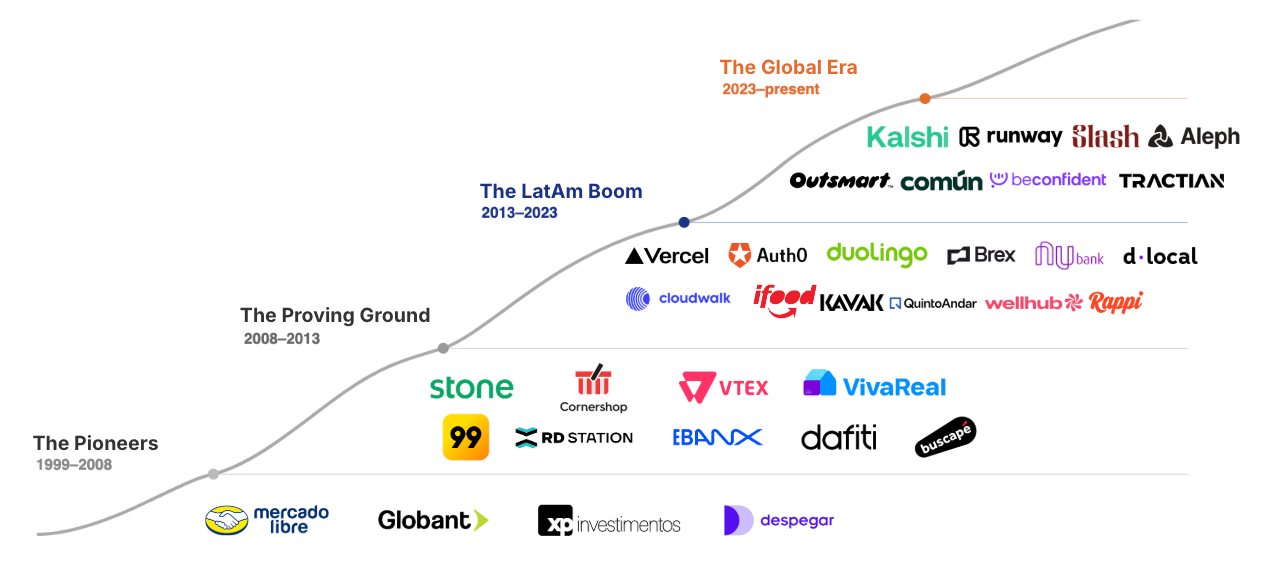
The dot-com era proved LatAm could produce technology companies. A small group of founders built internet businesses during the boom, survived the bust, and became the region's first reference points. Capital was scarce and mostly foreign. Ecosystems were nonexistent. But MercadoLibre, Despegar, Globant, and Patagon IPOed or exited, and in doing so, made everything that followed possible.
Post-GFC, a quieter but more consequential era began. Founders tested adapted versions of global models; marketplaces, early SaaS, web-first. Most didn't become unicorns, but they trained a generation of operators and product builders. More importantly, the first local institutional funds were formed (Kaszek, Monashees, Valor), creating a repeatable capital base for the first time. The talent pipeline became real, if still thin. Companies like 99Taxis, VivaReal, and RD Station defined this era.
The mobile and cloud revolutions arrived to LatAm and unlocked massive new TAMs, and ZIRP-era capital flooded into the region at unprecedented scale. Regional-first models (especially in fintech) scaled into unicorn territory. Nubank, Rappi, iFood, Kavak, QuintoAndar, and dLocal became household names and proof points for a generation.
But something else was happening in parallel. A handful of founders skipped the regional playbook entirely and went straight to the US: Brex, Auth0, Vercel, Duolingo. They didn't build for LatAm and then expand. They built for the world from day one and became the new role models.
Those two paths are now converging. We've been watching this shift happen in real time: in 2021, just 3.6% of Latitud Fellowship applicants were building for US-first, global markets. By 2025, that number had reached 46%.
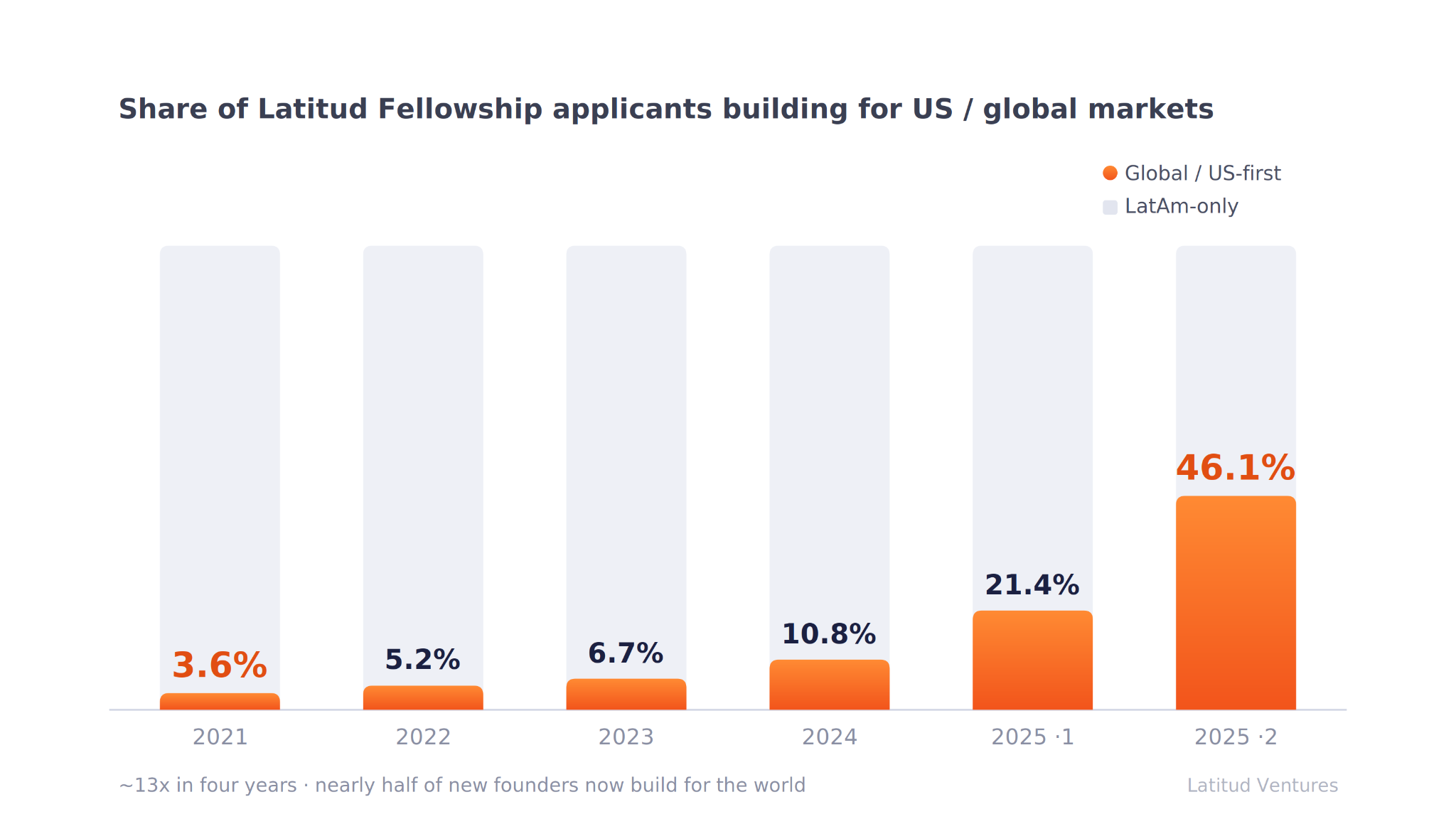
We're seeing dozens of founders per quarter moving to the US (mainly San Francisco), getting O1 visas (we're signing endorsement letters every week!), and building for the world at a rate we had never seen.
This is not a coincidence. It maps to late 2022, when ChatGPT went mainstream and AI stopped being a vertical and became the new infrastructure layer for everything. What is happening with LatAm talent is inseparable from the AI supercycle. The result is a generation of LatAm founders who think global from day one, moving to the US. Three tailwinds are driving it.
In 2025, the United States captured 79% of all AI funding. The Bay Area alone raised 60%, $122 billion, more than the rest of the world combined. When the technological frontier concentrates this dramatically, the calculus for ambitious founders anywhere in the world changes.
The best LatAm founders are among those now asking seriously how to compete in SF, not whether to. The competition is two to three times more intense. But the outcome ceiling is ten to thirty times higher. For a founder willing to make that bet, the math works.
For most of the last three decades, your geography determined your market. Fintech founders dealt with local regulation. Marketplace founders needed local supply and demand. Vertical SaaS founders served local buyers with local sales teams. Where you started was, for the most part, who you served and your moat.
AI has diffused those boundaries. Horizontal AI solutions, developer tools, infrastructure, automation layers... these don't care where your first customer is from. A three-person team in São Paulo or Buenos Aires can ship a product today that an engineer in Austin or Berlin pays for tomorrow.
For the first time, building locally is a strategic choice, not a constraint. The best founders are making that decision early. They're not asking "how do I build for LatAm and then expand?" They're asking "what is the biggest market in the world I can go after?"

It's easy to underestimate the power of role models.
What Ronaldo, Ronaldinho and Messi did for the generation of LatAm players that followed them, the first wave of global LatAm founders is now doing for the next generation of builders.
Marcos, Hernán and Stelleo at MercadoLibre were our Pelé: building a massive, public company from LatAm, for LatAm. It was proof that it could be done. The model was regional. Nubank followed that same path… at least for now, as they’re looking totackle the US market (might be our Maradona, conquering from Napoli in the second half of his prime years).
Then came our Ronaldos, Messis, and Suarez. Guillermo Rauch at Vercel, Henrique & Pedro at Brex, Luis Von Ahn at Duolingo, Matias & Eugenio at Auth0, Cesar at Wellhub. The first generation that left, competed in the Champions League of tech, and succeeded.
Now the Vinicius and Julian Alvarez’ are arriving. Kalshi, Runway, Slash, Tractian, Aleph. In Latitud’s own early portfolio, Outsmart, BeConfident and Taste AI. A new vintage of LatAm-born teams, younger, faster, and global from day one.
—
LatAm has historically under-indexed on the immigrant founder list, with roughly 15 unicorn founders represented. Given the size of the region, its depth of technical talent, and its proximity to the US market, it's only about time that we catch up. AI is providing the inflection point.
The gap was never talent. What was missing was connection to the main platform, and the ambition to compete globally.
We are not playing Copa Libertadores anymore. We are going after the Champions League.
.svg)


Disclosures for Latitud Finance
Latitud is not a bank. Banking, brokerage, FX, and other regulated activities are provided by our licensed partners in the United States and Brazil.
To become a Latitud Finance customer, you must agree to Latitud Finance’s Privacy Policy and Terms of Use.
Disclosures for US-Domiciled Latitud Finance Business Accounts
Some services that are part of your Latitud Finance Business Account are offered through Synapse Financial Technologies, Inc. and its affiliates (collectively, “Synapse”). Synapse is not a bank and is not affiliated with Latitud, Inc. Brokerage accounts and Cash Management Services are provided by Synapse Brokerage LLC (“Synapse Brokerage”), a registered broker dealer and member of FINRA and SIPC. You can find additional information about Synapse Brokerage on FINRA’s BrokerCheck. Please see Synapse’s Terms of Service, Privacy Policy, and the applicable disclosures and agreements available in Synapse’s Disclosure Library for more information.
Synapse Brokerage is a member of SIPC, which protects securities customers of its members up to $500,000 (including $250,000 for claims for cash). Funds maintained in the Synapse Brokerage Cash Management Program are deposited into one or more banks (“Program Banks”) where the funds are eligible for FDIC insurance up to $250,000. Please see your Brokerage Account Agreement and Synapse’s Terms of Service for further details. You can find a list of Partner Financial Institutions participating in a Synapse cash management program here.


.png)